
Proven ROI and operational efficiency for inpatient behavioral health
Organizations achieve measurable efficiency gains and rapid payback – breaking even within four months.
Better outcomes, lower costs
In behavioral health, one adverse event is not only detrimental to a patient’s recovery but can lead to millions in uncompensated care and "Immediate Jeopardy" citations. LIO offers a defensive hospital cost cutting strategy that pays for itself in months.
Annual impact for a 100-bed facility:1

Smarter hospital management
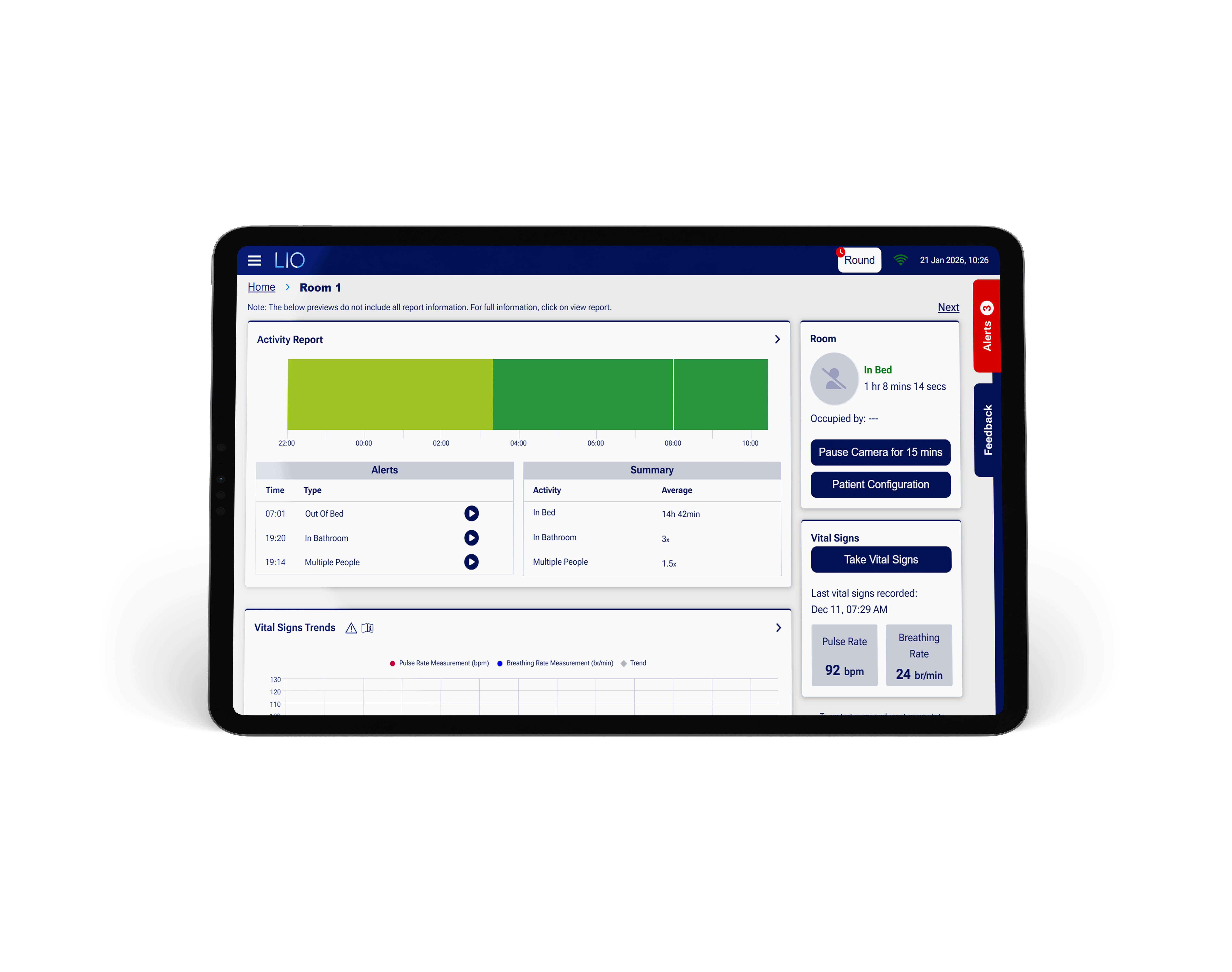
LIO fits effortlessly into your clinical workflows, maximizing staff productivity and providing the real-time data needed for effective operations.

Staff time savings
increase in the rate of obtaining accurate vital sign measurements7

One unified platform
Replace fragmented tools with one platform. LIO is the only platform to integrate digital rounding, ambient monitoring, and advanced compliance reporting, reducing your total costs.

Data-driven oversight
Live dashboards provide 100% visibility into rounding compliance, shielding you from costly fines and ensuring alignment with regulatory standards.

Contactless patient monitoring
Continuous vitals, sleep and activity insights without the need for wearables - eliminating the associated recurring inventory costs.

Increased high-acuity capacity
By enhancing situational awareness and staff confidence, LIO allows your facility to safely admit higher-acuity patients, optimizing your payer mix and top-line revenue.

Protecting your revenue and reputation
The most effective cost reduction technique in hospitals is by eliminating “Never Events” and staffing churn.
Lower litigation risk
Reducing costs by improving experience
Clinical outcomes with financial impact

Measurable impact
Every year, a 100-bed provider using LIO:
400
Prevents 400 safety incidents
32,500
Releases 32,500 hours of staff time
$800k
Achieves $800k in cash savings
Implementing the LIO platform at SummitStone Health Partners
Ready to implement cost savings for your hospital? Contact us for a personalized demo
Get in touch1. Buckley, C., et al. (2024). PLOS Digital Health, 3(9): e0000559; 2. Ndebele, F., et al. (2023). Journal of Mental Health, 33(3), 320-325; 3. Wright, K., & Singh, S. (2022). Journal of Patient Safety, 18(3), 177-181; 4. Ndebele, F., et al. (2022). Journal of Psychiatric Intensive Care, 18(2), 95-100.


